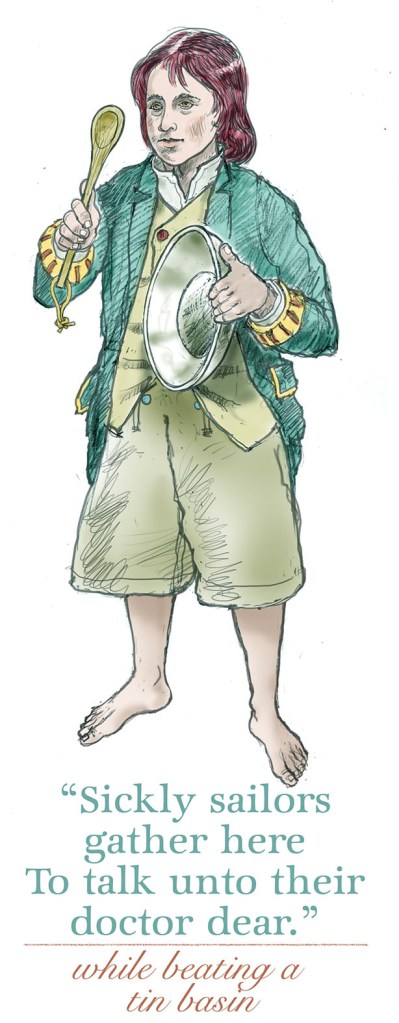
LOBLOLLY was a thin, bland gruel or soup given to children or to the sick whose digestion was suspect. The loblolly boy spooned loblolly into the mouths of sailors in the sick bay, the general area (“bay”) where swinging cots or horizontal bunks were reserved for debilitated or wounded crew. Part of loblolly boy’s duties was to help the ship’s surgeon.
Loblolly shouldn’t be confused with “portable soup,” which was a dehydrated broth of beef and/or veal. This was manufactured, not dinner-prepared, by simmering bony cuts of meat for six or eight hours. Beef feet were included to add more collagen (the substance of hooves and your fingernails) so the broth would gel more firmly when it was reduced. The gel was lightly powdered with flour and laid on cloth in the sun to dry, turned often, until was a light brown block. It was sold as blocks in several sizes and was as hard as a hoof. This “instant” soup was broken up and simmered in hot water as a light diet for sick sailors. We can’t attest to any nutrition in portable soup after all its boiling, drying, storing, and shipping, but it was hot and smelled meaty or – to some – gluey.
The ship’s surgeon was seldom a surgeon as we understand the title. “Surgeons” afloat weren’t deeply educated medical types but men who could read a book of first aid instructions (mostly bogus), had enough money to sit for a cursory test, received a certificate from the Sick and Hurt Board of the Admiralty, and could pay for their operating kit.
We still see, occasionally, a barber’s sign of red and white stripes; this combination of blood and bandages indicated the mediaeval place of the barber as a village medical center. A barber could take out a bad tooth, stitch an open wound, bind up a scrape, lance a boil, or even splint a broken bone. A ship’s surgeon had less experience with wounds and stood a bit lower on the social ladder than a village barber.
Higher on the ladder was a proper physician, who had some knowledge of anatomy and had read medical authorities at a university. In Latin and Greek medical students absorbed the medical wisdom compiled since Hippocrates.
Consequently, a sailor in distress of any kind would have been cared for far better by the barber because the basis of classical medicine around 1800 was pure bunkum. Learned medicine was based on balancing the four “humors” (fluids) of the body – blood, yellow bile, black bile, and phlegm – to achieve peak health. Each of these fluids was associated with a temperament. The antique physician associated blood (not gushing out of the body but indwelling) with heat and damp, and a patient of blood domination indicated a cheerful, brave, and resilient personality. Yellow bile suggested fiery, dry heat in an angry, overreaching, annoying person. Black bile had the character of cold and dry depression, a tendency toward hopelessness and, for some Greek or Latin reason, creativity. Phlegm, which we can witness in a runny nose, seemed cold and wet, and a phlegm-ish patient was assumed to be calm and unruffled but boring.
Over at Johns Hopkins or the Mayo Clinic, balancing humors isn’t a worthwhile pastime or even a good emergency room joke. The village barber had the advantage of local herbalists, “folk” remedies that sometimes worked in real time. Herbal remedies were largely empirical discoveries passed down for generations, like willow bark, chamomile, foxglove, and hawthorn. Some were and are effective therapeutics. Folk wound treatment could employ complex poultices – mashed herbal leaves and ingredients like ginger and mustard applied hot and cold to various wounds or skin problems. They were soothing, and the gloppy mess excluded worse infections. Herbals were mild adjuncts to good nursing, not miracle cures. Few of them were actually toxic – unlike the prescriptions given by the ship’s surgeon.
The healing professional of 1800 didn’t have the herbalist’s grandmotherly wisdom but went to jaw-clenching lengths to achieve the ancients’ ideal chord of humors. Blood letting was popular, draining away a liter of your blood to set your humors in harmony, right to the point of death. We believe that George Washington, a physically powerful man who might have survived pneumonia, was quickly put down by repeated, excessive blood drain. Balding, shaving hair down to the scalp, was recommended for fevers. Blistering the skin with burning salves made from irritants like Spanish Fly (cantharides) was meant to reverse humor-incompatibility. Cupping was a colorful practice of heating the inside of small glass tumblers before placing them on the skin in dozens, so as they cooled they sucked up a circle of skin and “drew out” poisons or disbalanced humors. Leeches were applied in droves on a dishumored body, swelling with the patient’s blood and, purportedly, “poisons.” [Note: leeches have returned to modern medicine and are respected applications for specific venous congestions in microsurgery and skin grafts.] Enemas using the clyster (the big tin tube below the medicine chest below, and being applied in the sick bay illustration toward the end) were used in conjunction with serious laxatives, getting those humors out and down.
In retrospect we admit that all these grisly “cures” must have had powerful placebo effects because they were so garishly dramatic. My mentor, the poet surgeon Dr. Matthew Finn, often growled, “The most powerful thing in my pharmacopeia is the placebo!”
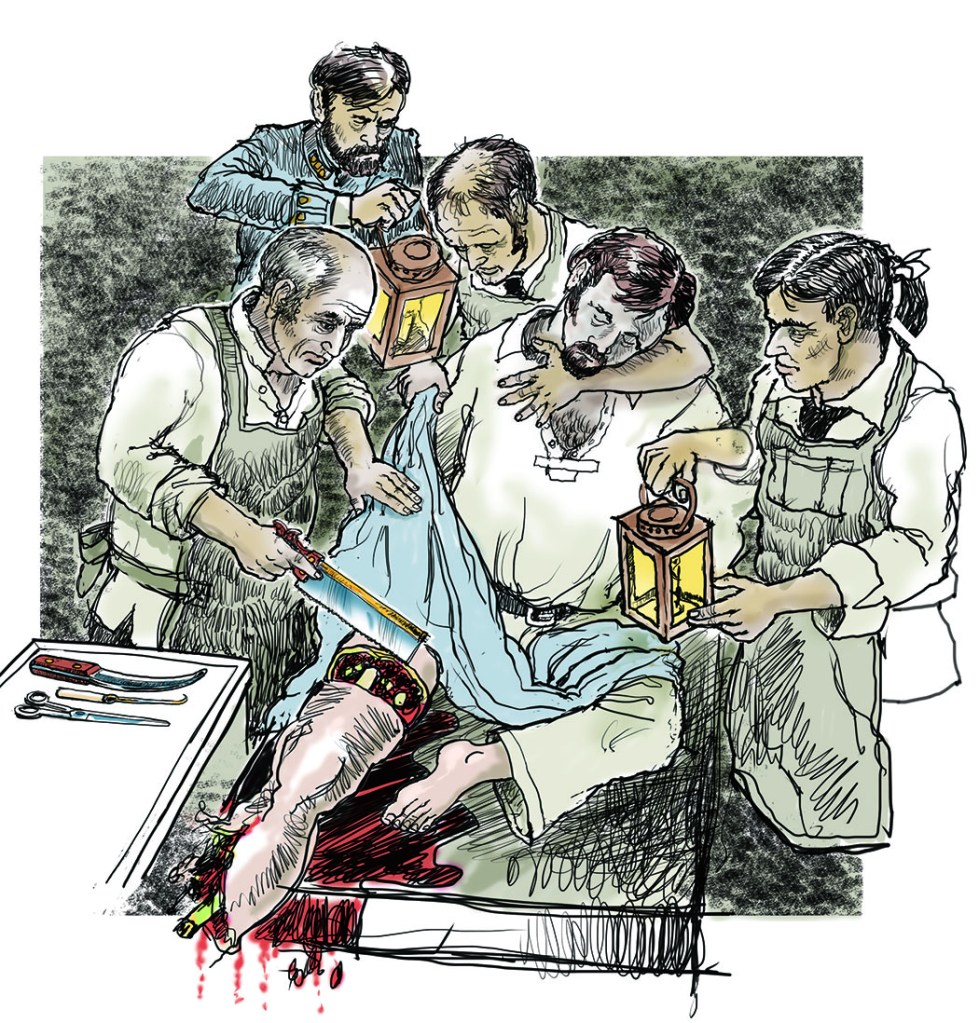
Regardless of the surgeon’s sketchy education, his reputation rested on one skill: amputation. Clean separation of any deep tissue wound was better than multiple small repairs inviting individual infection, far enough “above” the wound to avoid damaged flesh. The skill couldn’t be fussy. The best practitioners were quick, decisive, using a curved blade that sliced rapidly around the limb, through muscle and blood vessels to the bone, tying off bleeding major vessels, sawing through bone, and sewing an attached skin pad across the stump was done in a few agonizing minutes. Some surgeons dipped the stump in hot tar, which sounds like insult to injury but was effective, sterilizing the wound (something the surgeon of 1800 didn’t consider) and isolating it from further outside infection.
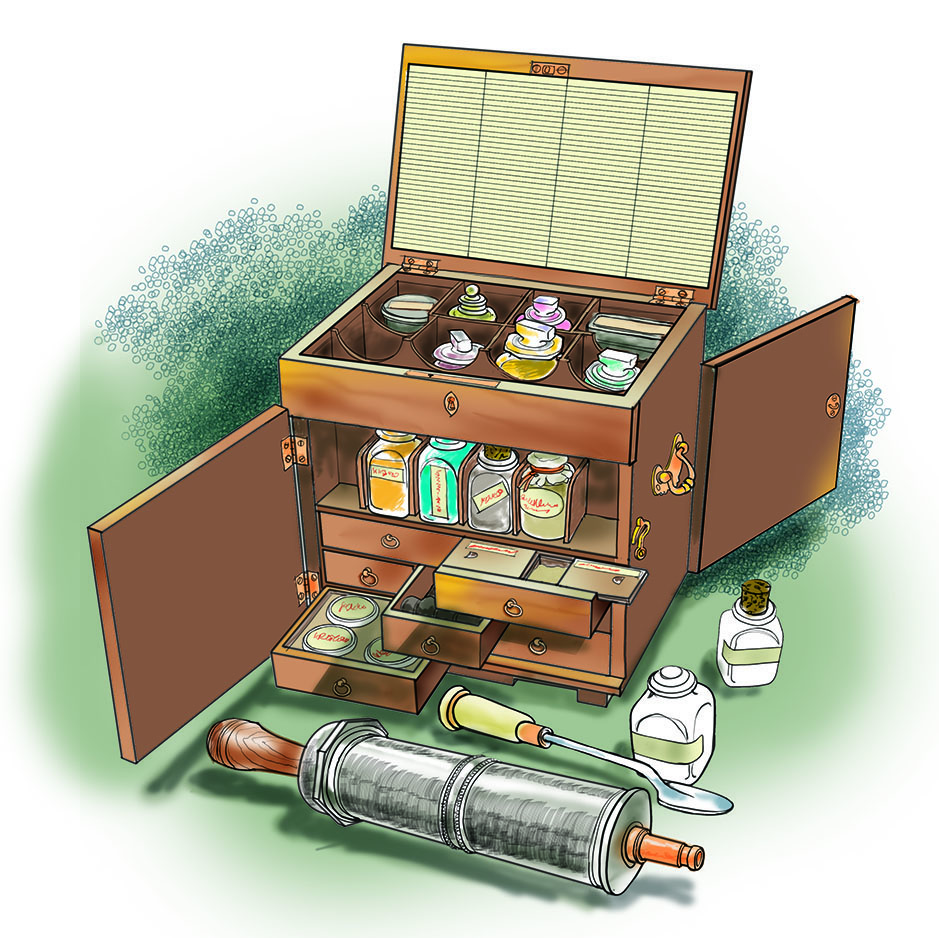
The ship’s surgeon was outfitted with a chest of drugs approved by the Sick and Hurt Board. The list of drugs is long but contains only one or two medicants with salubrious effects. Most are servants of the humors, proven to induce vomiting, diarrhea, sweating, or blistering. Some are quack remedies promoted by friends on the Board, like Bateman’s Pectoral Drops, Dover’s Powders, or Glauber’s Salts. These commercial nostrums often contained opium and/or alcohol, which accounts for their eager use.
Three drugs of the era stand out as medically powerful. Lime and lemon juice, mixed daily with the sailor’s ration of rum and water, was a specific against scurvy, the vitamin deficiency which took a terrible toll on crews on long voyages without fresh vegetables. Without citrus the Royal Navy would have been as effective as the Nebraskan Navy.
Laudanum is a form of opium in alcohol that can be taken orally. It softened terrible pain, reducing shock, and allowing rest, a Godsend. Laudanum and rum were the only pain relievers available.
Jesuit’s Bark, the dried bark of the Peruvian cinchona tree, treated malaria and severe fevers. Its effects were known to the Inca, who passed it to Jesuit Missionaries on the coast. Why did it work? The Jesuits and surgeons had no way of knowing, though their explanations might have been humorous.
Recognizing the power of the placebo the naval surgeon often added asafoetida to his tonics, a powder of such spectacularly bad smell that it was called “the devil’s dung.” The worse it smelled, the greater the effect.
Among the most prevalent drugs in the naval surgeon’s sick bay was mercury. Medically, it is part of an historical and psychosexual morass starkly delineated by an endemic disease with grave social overtones, syphilis.
Until 1910 and the extraordinary development of Salvarsan (an arsenical compound that binds to and destroys the helical spirochete germs of syphilis, a real cure) syphilis was an incurably fatal disease that swept through every class of European society since it appeared in 1493 with the return of Christopher Columbus’ Caribbean explorations. It was not a simple malady but a mysterious and destructive condition that could disappear for a time, disguise itself as many other ills, but reappear with malignant effects years later. It presents in four stages: primary, when one or several sores will be seen, usually on the genitals; secondary, presenting a rash on palms or the soles of feet plus soft-tissue lesions; latent, when all symptoms disappear, though the dormant infection is still in place; tertiary, when – sometimes years later – the returning infection attacks heart, lungs, liver, brain, bone, and may effect paralysis, dementia, stroke, pulmonary failure, and death.
The brothel, knocking shop, whorehouse, or crib was an accepted part of Regency society, just as concubines were expected parts of life in the orient and mistresses in the lives of European upper class men. A young man was expected to gain sexual experience with a professional.
Royal Navy or mercantile voyages of more than a year were not unusual. With few exceptions a ship was an all-male milieu and the punishment for “unnatural acts” (in a vessel without privacy) was death. Returning to port, sexual tensions were exaggerated. When Jack Tar returned it was rare to forbid the ship – the sailors’ home, after all – to sailors’ wives, permanent or temporary, paid or unpaid. The open berth deck of a moored ship between voyages was as lively and shocking as an Hieronymus Bosch painting. Shore leave offered two primary destinations: the pub and the brothel. A refitted and reprovisioned ship leaving port carried an astonishing cargo of syphilis infections.
Prudery does us no good. A walk through the lyrics of “As Time Goes By” assures us that the mating instinct and animal attraction is firmly seated.
The ship’s surgeon was ready to dose his sufferers. The university approved cure for syphilis was well-documented and the treatment was standard: blue ointment. This was a mixture of metallic mercury in lard or fat, to be rubbed directly on the primary syphilitic sores called chancres. Syphilis patients also took “the blue pill,” more mercury. This sovereign treatment coined the phrase “A night with Venus and a lifetime with Mercury.”
Because the disease has a latent period, mercury treatment was considered a cure. It was not. Moreover, the effects of mercury poisoning were often fatal in themselves. Two symptoms of mercury poisoning – excessive salivation and sweating – were welcomed as excellent signs of humor reconciliation. Sailors who died of mercury poisoning were assumed to have succumbed to syphilis rather than the surgeon’s liberal doses. The many sequelae of mercury poisoning – organ failure, weakness, loss of coordination, mental confusion, visual difficulties, persistent nausea – were also written off to syphilis. Looking back we are seeing that bad medicine ingrained in respect for ancient authorities was worse than ineffective; it was often deadly. In pitiful hindsight it’s clear that simple observation and a bit of number analysis could have disproven the medical basis for “balancing the humors” but the practice was protected by the imprimatur of ancient wisdom and “higher education.”
One of the most astonishing facts we learn in hindsight is that Jack Tar must have possessed herculean natural immunities to survive conditions and treatment so contrary to survival.
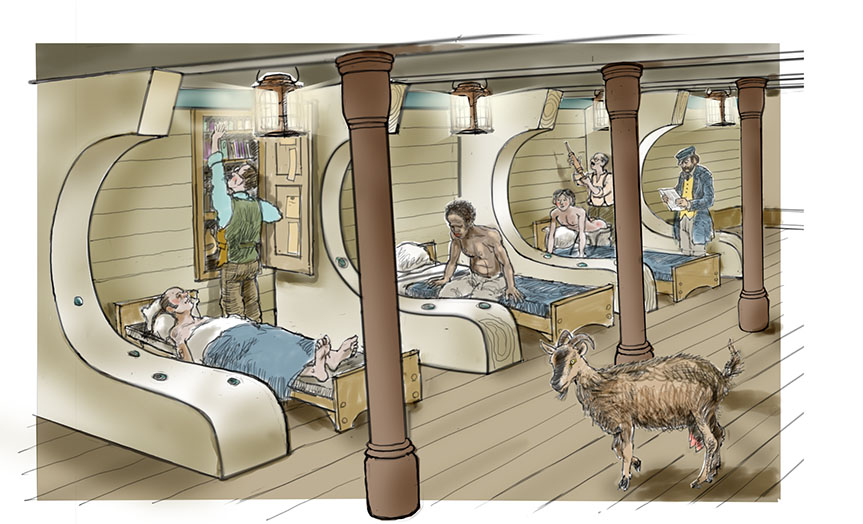
The loblolly boy wasn’t always a boy, and this brings up a pretty point. He could have been an older sailor, a waister. Recall an early Dockwalloping that asked about the surprising number of children, “little nippers,” boys from six on, who lived and worked hard hours aboard a man o’ war or merchantman. What happened to elder sailors? Yes, many died in poor conditions but not all “expired.” What was the age demographic for a ship’s crew, and where in the ship’s curious social hierarchy did elders, foretopmen, little nippers, midshipmen, and warrant officers fit? We’ll address the ship’s complement in the next Dockwalloping.

Your comment, dissent, data, and support are welcome