THERE’S A FELLAH somewhere in DC who has been given a dandy position and a swell office. He bought new ties and has his name on the door over Bob Gilka’s somber warning, “Wipe knees before entering.” I’m in mind to give this jasper a short cruise about half way across Penobscot Bay.
This urban wonder, allotted his position as a maritime mogul in recognition of his large cash donation to election campaigns, has been mandated to “save maritime money.” As soon as he looked up the definition of “maritime” he got to work, furiously looking for pork fat to cut out of nautical budgets, and fetched up on a sprightly notion.
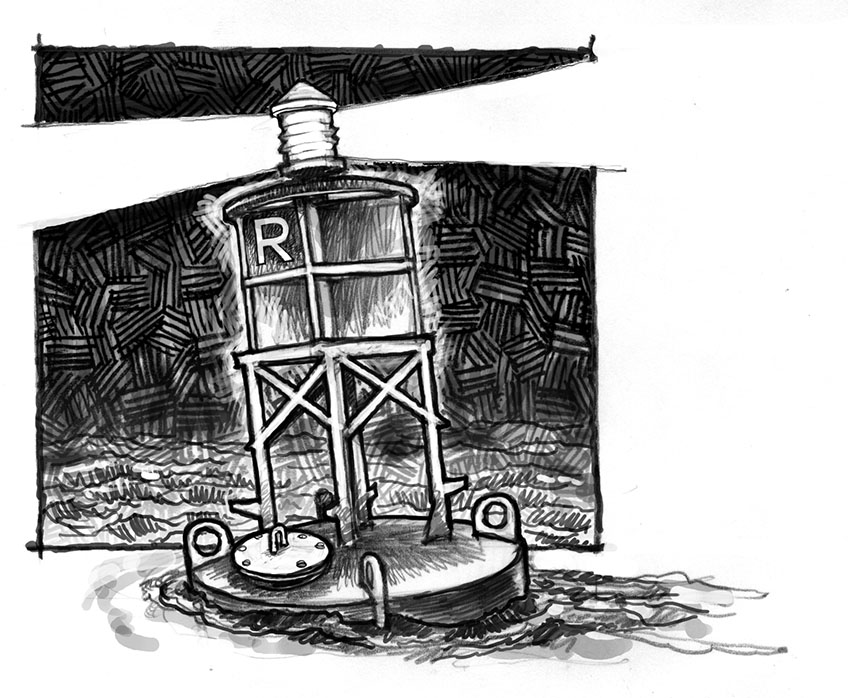
Someone at the water cooler mentioned that maintaining navigation marks – cans, nuns, beacons, daymarks – is expensive. Simple solution: cut out the navigation markers.
The Coasties and NOAA field operatives are pulling navigation marks out of the water.
It’s hard to put this down in print but cans and nuns marking the wicked channels of Woods Hole are scheduled to be retired. The grinding of Cuttyhunkers’ teeth can be heard as far as New Bedford. The legion of boaters who have wrecked their dear boats against Woods Hole bricks are delighted: “Good! Now we’ll see how those other guys feel!” Lobstermen are walking inland carrying their anchors.
A fearful aide approached the maritime mogul and cited the likely toll of floating corpses along the coast. The sea-boss reply was short and optimistic: “Ridiculous! Most people don’t bother looking at those old iron things. They use GPS and iPhones to show them where to go.”
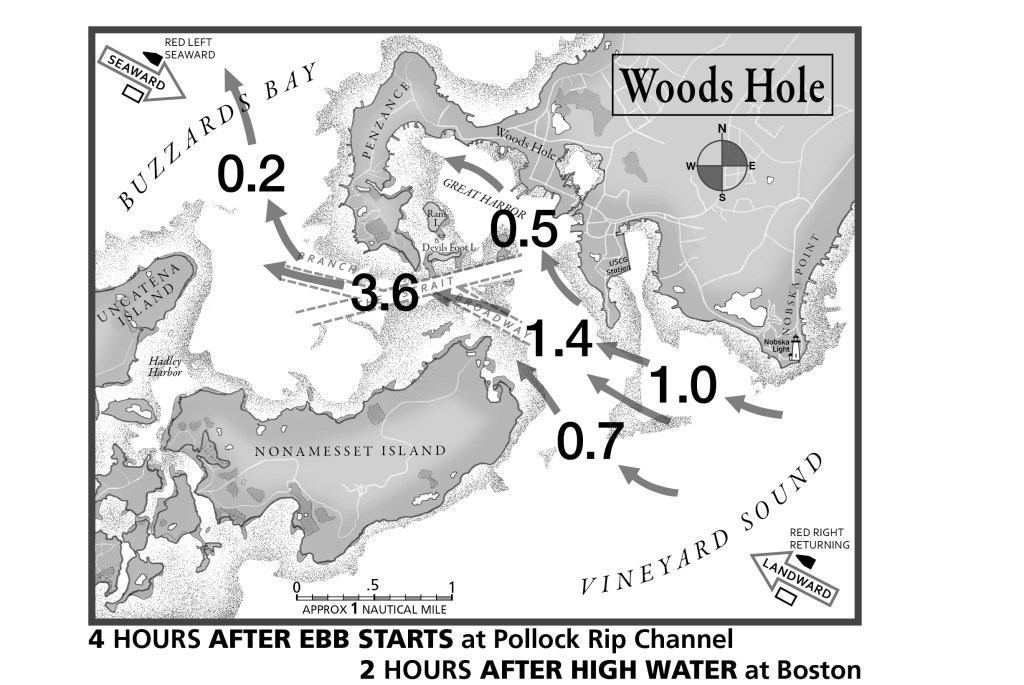
Passing through Woods Hole with or against the tide (the latter is safer), is never a lark. Every mariner I know has taken that passage in the fear of God and after reminding himself that the red marks will not be on his right as he enters from Buzzards Bay (convention stipulates red-right-returning operates offshore to inshore, so the nuns are on the north sides of the channels). The displacing, treacherous currents at moon tide suck Number 3 under the water and tosses it back and forth like a toy so it boils up over there, then over here toward your hull. You can glimpse killer rocks shooting past under the surface with red, blue, and green smears of bottom paint on their granite faces. You can know the Hole like your way to the toilet in the middle of the night but the Prudent Mariner has the chart (another vanishing item) laid out beside the wheel every time. In the midst of this maelstrom, trying to focus on your hand-held iPhone is contraindicated.
What the fascist sea-boss doesn’t, can’t know is that every mark is crucial for multiple reasons. Every time you pass a mark you read the current and remind yourself of azimuth versus line traveled. The marks offer important perspective and sense of real location. You don’t set pots at beacon 13 but somewhere half-way from 13 to 12 and a bit toward 15, where the bottom drops off. A nun, can, or daymark doesn’t always mark the channel! The mariner recognizes the mark as a reminder that the sea is an active process of shifting silt and moon driven currents.
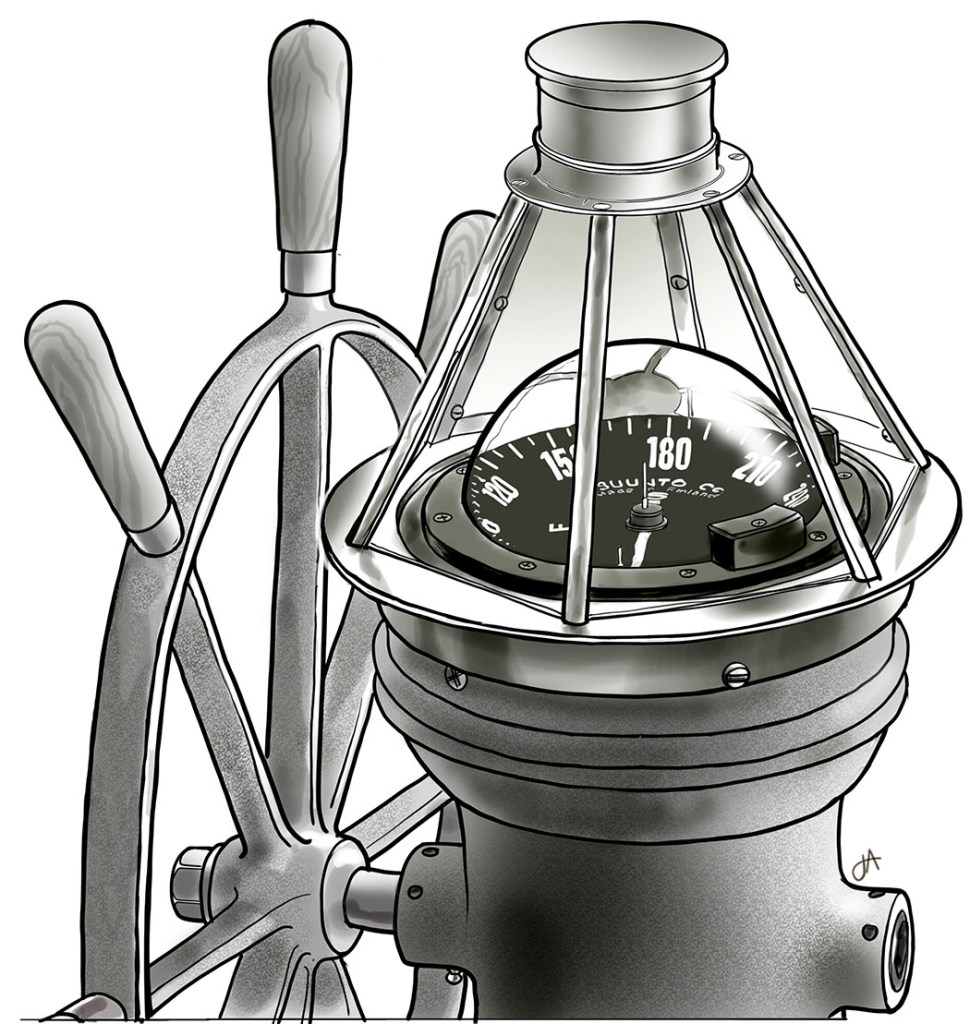
No one loves GPS more than mariners, yet every skipper counts on the nav-marks to orient his progress on the deceptive, dancing surface. And the technical, electronic glory of GPS is, shipmates, transitory.
You can’t carry on hydrogen nuclear fusion in an orderly manner. Our sun is a peevish god. Often an eruption of pure energy darts out of the sun’s surface, a solar flare or coronal mass ejection. These are directional and, blessedly, most aim elsewhere. Early in September of 1859 English astronomers Richard Carrington and Richard Hodgson were studying sunspots and noted a solar flare. They didn’t know what to expect but the next day geomagnetic energy of the flare reached Earth.
Two major effects of this energy pulse, which we call the Carrington Event, were obvious. One occurred that night, a fantastic display of the Aurora Borealis, usually confined to Arctic regions but brighter than ever before and visible as far south as southern Mexico and Cuba. Gold miners in the Rockies were awakened early, thinking the dawn had arrived. In New England the aurora made enough light to read newspapers. Similar effects from the Aurora Australis were seen in Australia, lovely displays, charming millions.
Another effect was the geomagnetic electrical effect, generating current in the telegraph lines acting as antennae. The massive overload burned out thousands of telegraph stations across the United States, knocking some telegraphists back from their keys, fusing connections, starting fires. Curiously, some telegraphists, frightened of the imposed current, shut down their batteries but were able to carry on messaging for hours without batteries, using the current surging in the wires.
The Carrington Event was impressive but not unusual. We’ve had many solar flare events since then. Less powerful flares occurred in 1872, 1921, 1938, 1941, 1958, 1959. A flare in 1960 caused widespread radio interference. In March, 1989, a large solar storm struck Earth, producing so much auroral activity that millions feared the beginning of a Cold War nuclear exchange. Physically, the flare shut down electric service in most of Quebec. These flares occurred in another era: a strong geomagnetic strike from a solar flare today could knock out our entire constellation of GPS satellites and our communication satellites overnight. Solar flares aren’t exceptional but inevitable.
The sea is great, and it exists in a greater sea of geomagnetism and nuclear fusion. Arrogant decisions made by urban, terrestrial bookkeepers are pitifully shortsighted. In this blog we talk about history and heritage and respect for old cranky methods we may need again. Requesting a safe passage through Woods Hole from a dead iPhone is bad juju. A few reliable cans and nuns, old iron relics, would be welcome.


Leave a reply to janiemeneely Cancel reply