Punishment Aboardship
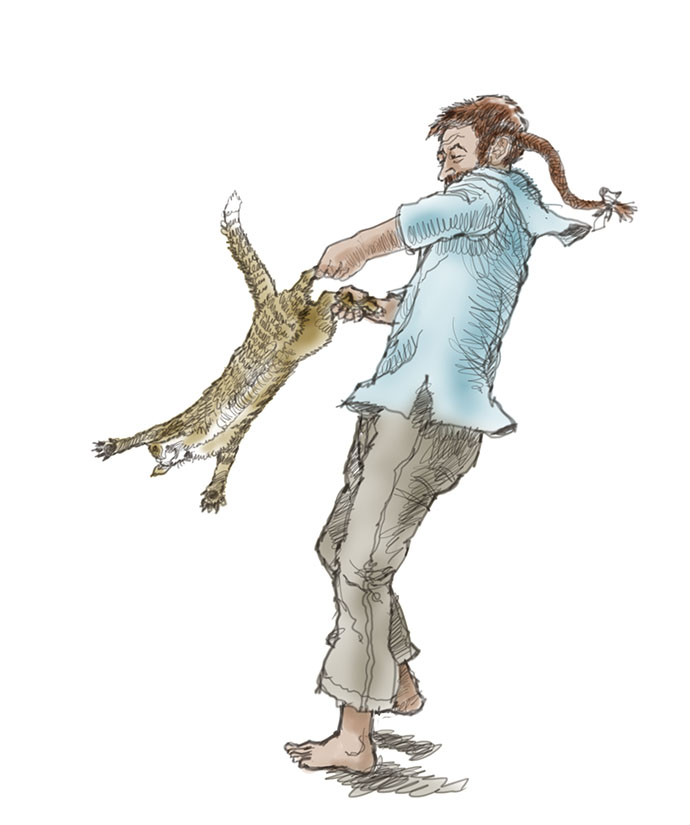
Swinging a cat?
SHIPS ARE THRIFTY OF SPACE. A fleet-rated Royal Navy man o’ war around 1800 was a compromise, really more a cargo ship than a flyer.
Most formidably the vessel was required to provide a stable battery for 30 to 100 guns. Lucky Jack Aubrey’s Surprise carried 36 twelve pounders, each weighing more than 4000 pounds with its oak carriage, dominating the gundeck space when bowsed up to the hull or freed for firing. Its contemporary American belligerent, Constitution, carried 30 twenty-four pounder long guns on the gun deck and 22-24 thirty-two pounder carronades (smaller short-range guns) on the spar deck, plus a pair of long-barrel bow chasers. Living with and on and over these heavyweight shipmates, the man o’ war’s crew occupied the little space remaining.
Fleet logistics demanded more cargo space than living space. For a voyage of many months the ship required immense amounts of water, salted beef and pork, hard ships biscuits, dried peas, tobacco, rum – hundreds of daily necessities for about two hundred men and boys. Space was precious.
Only one man had plenty of room: the captain had an elegant Great Room over the rudder for dining and entertaining guests, a small sleeping cabin and, built into blisters at the quarters of the barkie, two heads(toilets, weather and lee, naturally). True, the sumptuous captain’s quarters had a tactical disadvantage: it was situated on the gun deck and housed two or four cannons. When the ship went into action – in practice or in actual combat – the captain’s cabin walls were knocked down, using a maul to dislodge the wedges that kept them in place. Modern sailors use a phrase from this era: “a clean sweep fore and aft.” This sounds like charwomen are arriving with brooms to tidy the deck. No, this refers to the knock-down of all gun deck walls (normally carried out in less that ten minutes by many hands) to open the sweep of the entire gun deck for serious business, unencumbered.
Officers ate and slept on the mess- or berth-deck below the captain’s quarters. Their “gun room” had no guns but a central table built forward of the mizzen mast. Outboard of this dining table cabins only slightly larger than a bunk were separated by wood panel walls about the thickness of a finger. Officers shared a toilet room with a closed stool emptied by seamen or, on larger ships, their own side-projecting head structure, just like the wall-hanging jakes of shore buildings and castles.
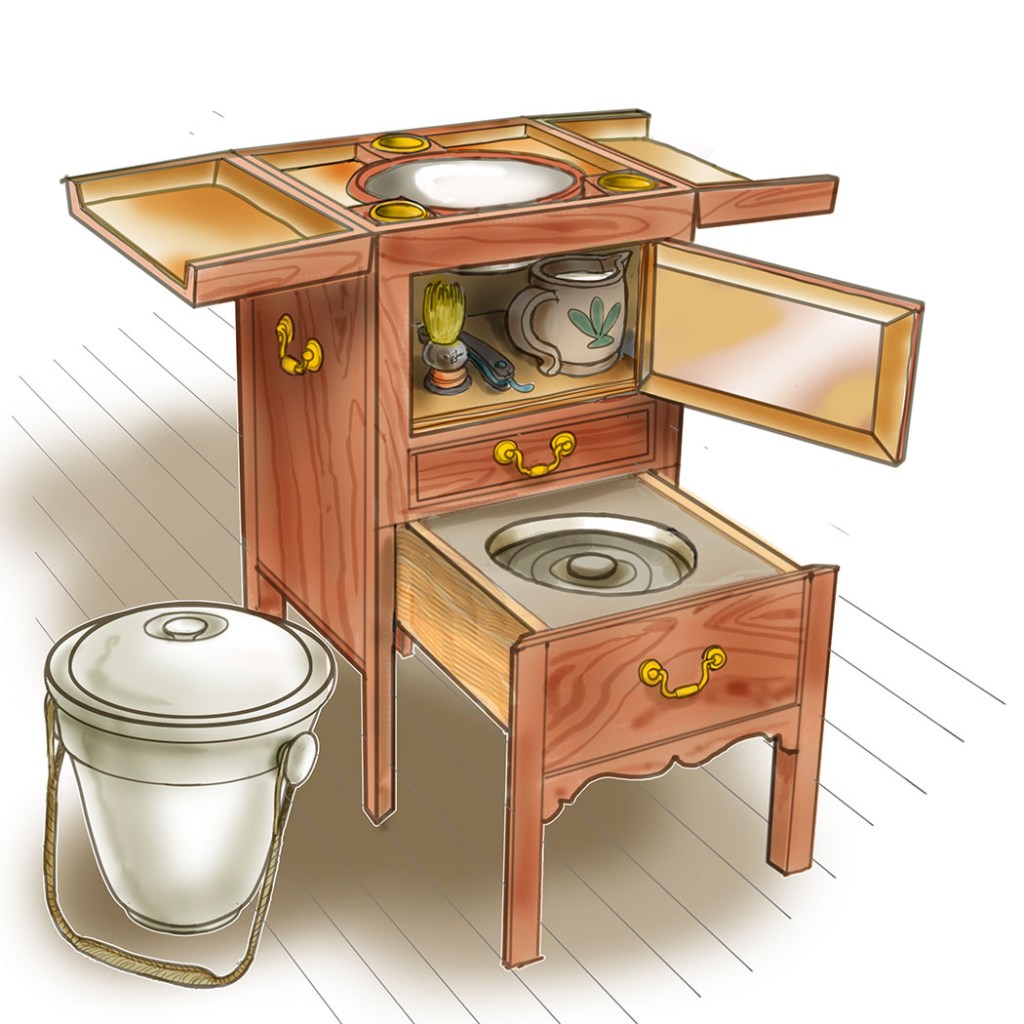
A slop jar and a “close stool” combined with a wash stand, officers’ comforts to be emptied overboard by seamen.
Forward of officers’ quarters at least half the hands were always home, sleeping their four-hour (eight bell) shifts off-deck or dining at mess tables – the outboard end fastened to the hull’s inner planking (ceiling) and the inboard end suspended with line from a beam above. The crew slept in canvas hammocks hung fore-and-aft from beams, swinging athwartships with the roll. Each sailor had a width of 28” to sleep and swing. Not roomy. The entire crew shared a few seats of ease (toilets) set into the little deck around the bowsprit, over the water, inboard of the ship’s complex beak beams. There may also have been lead cones, pissdales, for peeing, draining outboard. In rough weather there was no thought of hitting the head with waves rolling over it. There were thundermugs, ceramic toilet pots with covers, to empty overboard.
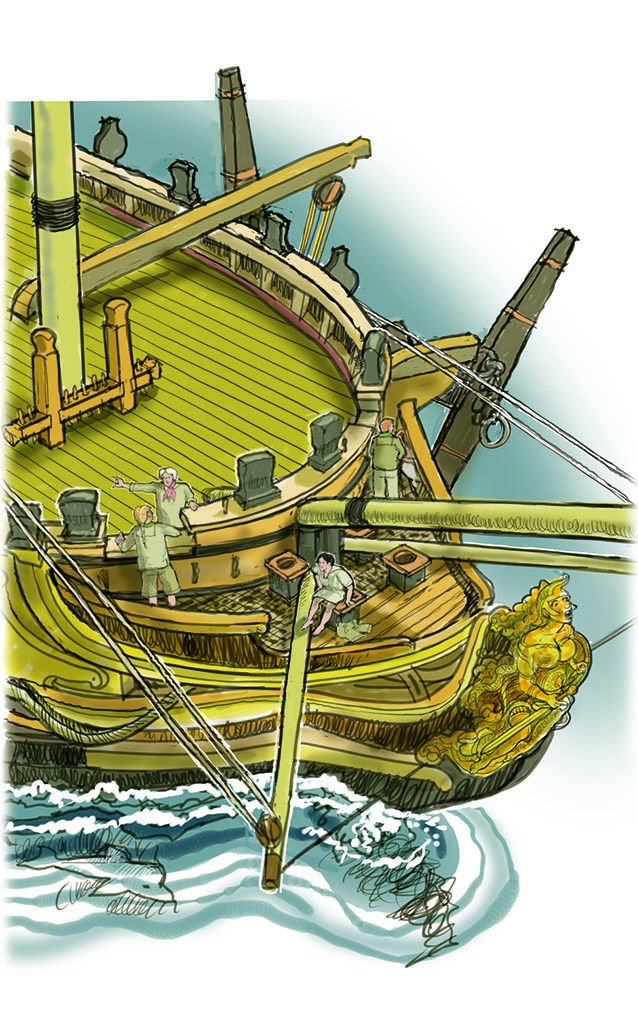
Seamen’s “heads” at the very head of the barkie, using the complex beak beams as locations for drop-through “seats of ease,” four shown here. In the upper port corner of the beak space we see a seaman relieving himself through one of the out-board-funneled pissdales, often fashioned from plumbing lead.
No place in a man o’ war was unused. The upper spar deck was crowded overhead with the ship’s boats and spare spars lashed to skids. At deck level there were hundreds of cleats and belaying pins set into rail holes and into the four-square fife rails around the masts, controlling that mast’s halyards and control lines. Necessity didn’t leave much room to circulate, so a sailor might say there wasn’t enough room to swing a cat.
Yes, most ships had cats aboard as efficient ratters. And perhaps cats offered the crew some kind of recognition and affection in a hard service. But those furry cats never got dizzy.
Sailors knew that the swinging was done by the infamous cat o’ nine tails, a wickedly efficient flogging device that provided most of the punishment aboardship. There were lesser punishments for minor offenses – stopping a man’s grog for several days or assigning exclusive duty to cleaning the heads on the beak. But for more serious offenses short of hanging [an intricate process we’ll visit in another blog], corporal punishment by flogging was standard.
Was there much flogging? Sweep aside romantic notions of seamen’s lives. The crew of a man o’ war was a miserable collection of bottom rung men brutalized by life and by incontrovertibly rigid discipline. The discipline was imposed by upper-class officers who often lacked fellow feeling for “working men.” Obedience was instantly required. On rigidly disciplined ships the crew was not allowed to speak on deck. Mature men were required to obey commands from midshipmen, occasionally pre-teens. Midshipmen were officers in training, the sons of wealthy families who used their influence to place their children early on a course of advancement. Instant obedience didn’t come easy to farmers, weavers, shepherds, or artisans kidnapped from their shore life by a Royal Navy press gang, without appeal. It was a hard life held in check only by threat. The food was – by our standards – awful, inedible, half-spoiled, monotonous. Disease was not avoidable [another blog to come] and the Georgian standard of medical attention was largely more harmful than the maladies treated.
A captain might sail with a crew half made up of convicts, pressed men, lunatics, and developmentally disabled landsmen. He “worked them up” with harsh punishment meant to shock and frighten them. Some “flogging” captains levied sentences of fifty and a hundred lashes.
Fifty lashes could kill a frail landsman. It’s useless to assign blame or shame to officers and seamen of another time; it’s not your time and you weren’t steeped in the frail, unlovely life they led. There were accounts of heroic officers but no chronicler of the tars before the mast in a wooden prison ranging over the ocean.
As some index of life during the Napoleonic Wars you may have read Jane Austin’s Sense and Sensibility(1811) or Pride and Prejudice (1813) but they are sanitized views of manners and society in urban and country settings, reality under glass, meant to demonstrate a growing awareness of women in polite society and the relatively new romantic concept of love transforming a world broken by distinct and widely disassociated classes of society.
Half a century later Charlotte Bronté published Jane Eyre (1847). Wuthering Heights, by her sister Emily Bronté, appeared in that year. Charles Dickens “A Christmas Carol” is also from the mid-century. They are stories of a new society changing gradually with the growth of industry, still tied to the stone steps of class hierarchy, worlds as separate from Jack Tar as a tribe of Watusi in Africa.
Was the sailor’s life better in some ways than the ceaseless work and grinding poverty of British urban or rural life ashore? Debatable. The sailor’s life was regular in food service and daily tots of strong spirits. Many had known times ashore when food was scarce. Navy life was predictable, and this regularity must have appealed to some. It’s likely sailors had an emotional connection to their ships. They might even think of themselves as critical parts of British sea dominance. They might believe that they were being cared for – roughly, not always fairly, but usefully. They were a part of something, of an empire, even if violent punishment could be called down at any time.
The instrument of correction, punishment, and example was the cat. It was a hidden, ritual instrument as jealously sequestered as an ark in a temple or a bishop’s mitre in a cathedral, kept in a red baize bag. When this bag appeared, bad things were about to happen, and a shipmate might express surprise, using another sailor’s phrase we often misconstrue: “Damn, the cat’s out of the bag!”
A whip of nine hard-laid, waxed cords no thicker than ⅛ inch was set into a handle, usually of wood. We might expect such a significant item to be decorated by fancy coxcoaming (intricate knotting). Each cord was several feet long and carried three tight knots.
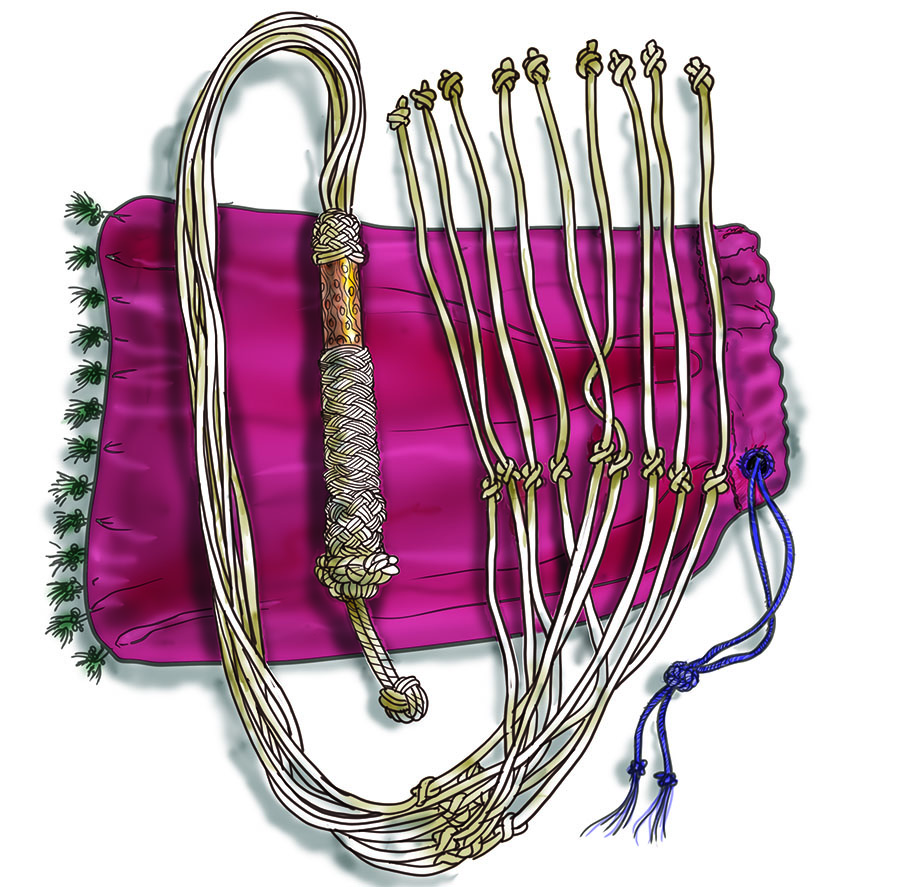
The infamous cat o’ nine tails in its red baize bag, pretties with fancy knot work as a ceremonial object.
The shipmate sentenced to be flogged was trussed up, usually against the inboard verticals of the main or forward shrouds. His shirt was removed. The cat was applied by the bosun or by one of his mates and applied heartily regardless of the flogger’s relationship with the celebrant. If the cat wasn’t given a full and forceful whip, the flogger might be ordered to exchange places with the flogee. The strokes were counted aloud. A dozen lashes would certainly open up the toughest tar’s back and produce copious blood. After the requisite number of lashes a bucket of sea water was poured over the celebrant’s back, he was cut down, and his debt was paid. His tablemates – the group of men with whom he ate on the mess deck – might each give him a bit of their rum ration to bolster his healing.
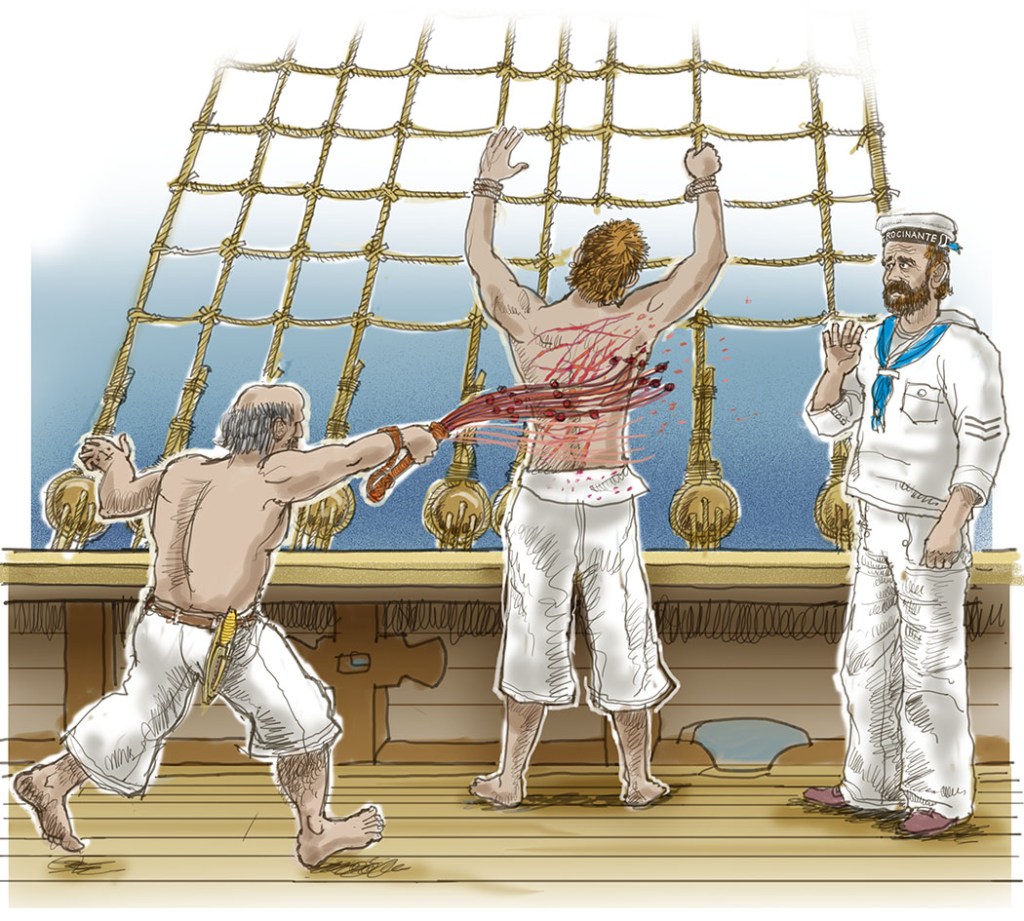
Corporal punishment is not part of our contemporary jurisprudence. The last state to allow flogging was Delaware; its last whipping occurred in the 1950’s, but their whipping post was officially retired in 1972. The United State Navy struck it off in 1850. The Royal employed its disciplinary effects into the early 20th century. Fifteen of the United States still allow paddling as a punishment for disruptive students in schools, though enlightened educational authorities are making progress against it.
It’s remarkably disturbing to illustrate a flogging, as if the artist is somehow complicit in what is – by our age’s standards, remember – barbaric show of unquestionable discipline, class distance, humbling force and pain. This much can be said for its shipboard practicality: it was over quickly, the disgrace was paid for by pain, and the incident is closed. The cat returned to the bag.

Your comment, dissent, data, and support are welcome