Myth or Horror ?
First, an apology.

These are crushing news days to an old journalist. ICE and Epstein have built up a depression that slowed me. Dockwalloping posts faltered. I started this blog because the publishing world, as I knew it, is gone. I’ve lost track of how many books I’ve published, somewhere north of 45, and they all murmur to me early in the morning, “Shouldn’t you be working on a book?” Apparently not. Attention spans, editors tell me, have shrunk to microscopic size and my usual history subjects – detailed, demanding – are passé. My Skills 101 gig for WoodenBoat Magazine has been my only public voice. Yet I’m not giving up: I mean to tend my garden. With this new blog entry I assure you that I will not betray your kind attention. Thank you for your patience. Any suggestions as to how I might increase the Dockwalloping membership will be gratefully received.
Having begun with a polite apology, I’m a bit surprised at the ferocity of the subject. Ouch.

KEELHAULING was a punishment meted to sailors between 1650 and 1882.
We hazard the earlier date as an artifact of more highly organized navies with codified maritime laws governing the behavior of crew and officers, because the procedure requires elaborate preparation and a body of acquired skills.
The latter date is historically noted: two Egyptian sailors charged with attempted murder were keelhauled by the Egyptian Navy in Alexandria in 1882. The grotesque nature of the practice disseminated by telegraph and reported internationally in metropolitan city newspapers probably laid keelhauling to rest. Though death was the usual result of keelhauling, some celebrants survived; both Egyptians lived on. The Royal Navy insists that keelhauling was struck off as a legitimate punishment after 1860.
From our humanist worldview it’s logical to doubt common reports of such a drastic punishment as myth rather than practice.
Its association with pirate tales casts doubt on truth. In researching my book What If You Met a Pirate? I discovered that the maritime world overestimated the wild practice and the lurid reputation of piracy as a justification for commercial losses. Many “pirates” were benign black market merchants, landing cargoes without paying customs duties. This more benign form of barratry (the illegal use of a vessel) was common after the buccaneering “golden age of piracy” (~ 1680 to 1720) in the Caribbean and along the Atlantic coasts of the Americas.
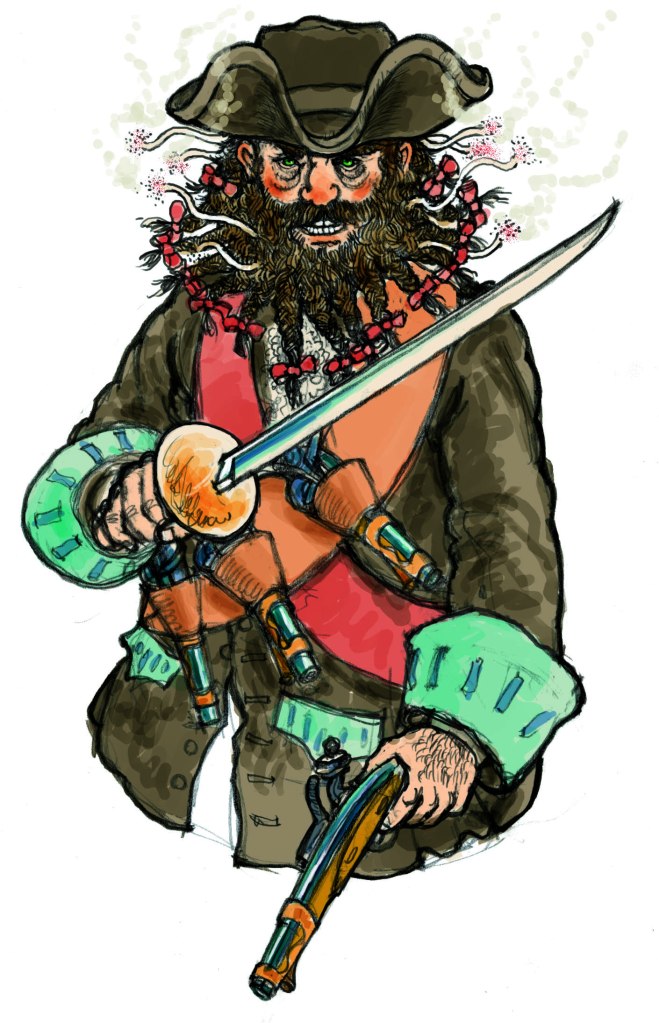
from What If You Met a Pirate ? WoodenBoat Books (icon on blog page)
Hoping that history will be kind and gentle never works out. Historically, keelhauling was institutionalized in several European navies as a punishment beyond hanging. Some sentenced to keelhauling requested a quick death at the yardarm to the awful pain and probable death beneath the ship.
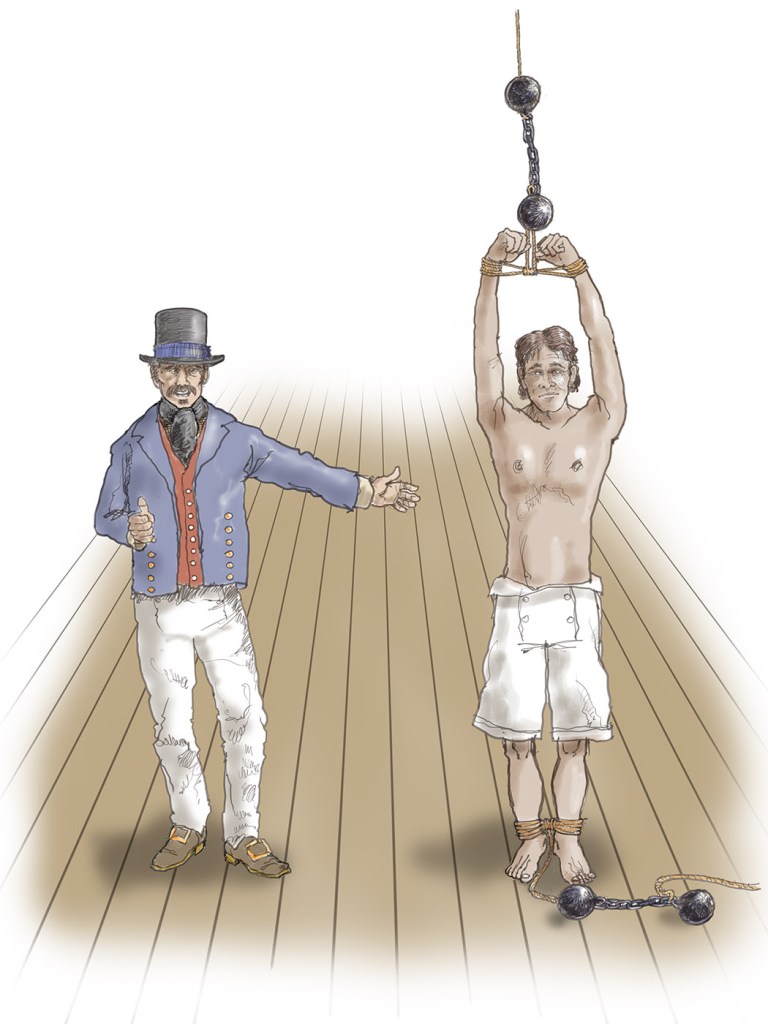
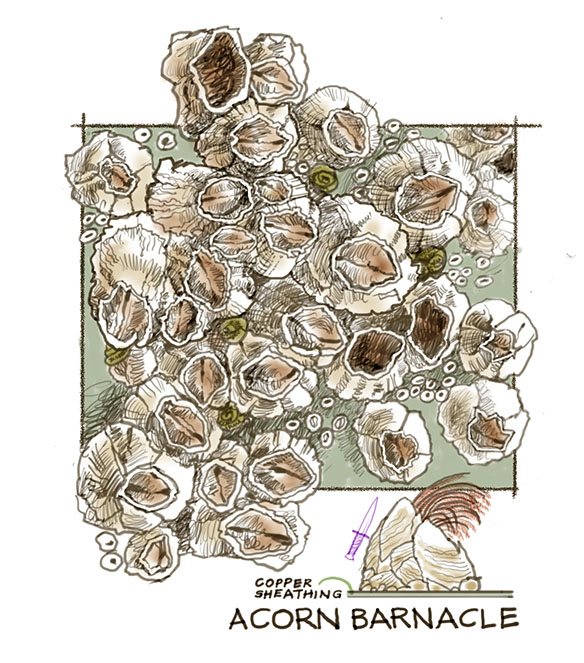
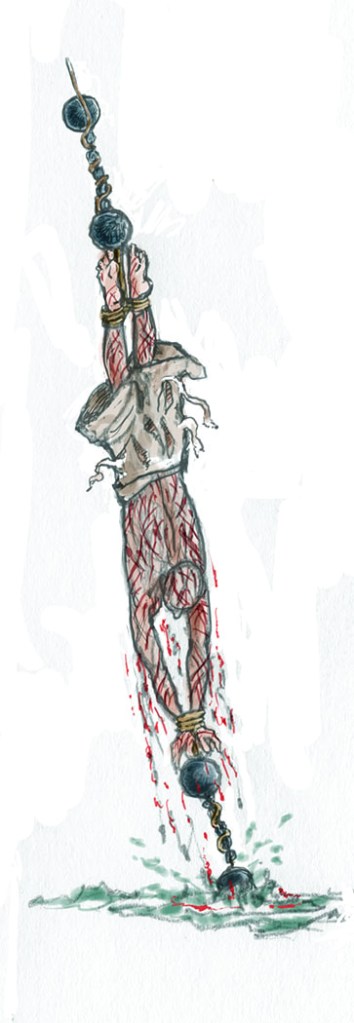
Surely there were variations to the practice but, largely, the operation was relatively simple. The condemned celebrant was bound by the wrists with one line and by the ankles with another. Both lines ran through simple whips (single-sheaved pullies), one to the starboard course’s yard end of mainmast or foremast, the other ran beneath the hull, and up to the corresponding port yard end. The celebrant was stripped and weighted with cannonballs and/or chain. He was dropped into the water and hauled forcefully from starboard to port, dragging him down (the draft of a frigate was between 15 and 25 feet) along the starboard hull, over the keel, and up along the port hull, to break water sooner or later under the port yardarm. The copper sheeting covering a ship’s hull was invariably covered with uncountable marine growths, predominately barnacles, one to four inches in size. Anyone who has waded in a tide pool or bumped against a salt water piling at low tide will have regretted the uncannily sharp points of the barnacle’s parietal shell and operculum. For a soft beachcomber even a casual brush is a painful disaster. Being hauled by force through a bristling forest of ragged knives would be unconceivable pain. The likely and most merciful result was drowning.
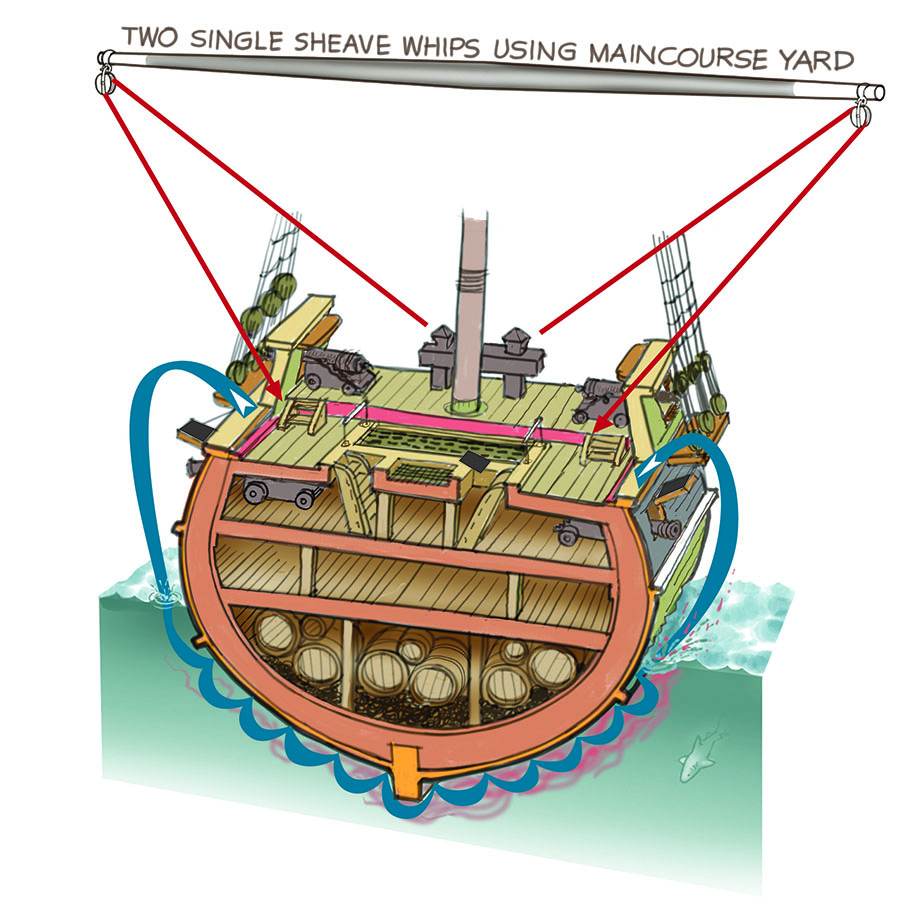
It was not unknown that a single pass under the hull might be repeated by captains demanding a disciplinary example before a surly crew. A one-way pass would scar the celebrant for life. Losing one or two limbs to amputation was likely, and the prospect of gangrene in the multitude of wounds was more than possible. Depending on location and latitude sharks, curious and perceptive creatures, might be attracted to fuss in the water and driven into a feeding frenzy by blood.
Returning to our humanist perspective, it’s impossible for us to conceive of any offense that called for keelhauling. Yet we can’t judge shipboard discipline at the beginning of the 19th century with 21st century sensitivities. By our lights we can’t weigh the balance between efficiency and discipline among crews composed of men confined to their ships for years, paid sporadically, fed abominably, punished for minor infractions of subservience, living in bitter conditions harsher than any contemporary prison. Jack Tar’s life was grim. Those crews were in significant part pressed men, poachers and petty thieves sentenced to serve by criminal courts, workhouse debtors, and sufferers jettisoned by asylums. Every ship must have been delicately balanced between hard horse officers and obedience. Even so, ascribing the coldest heart and deepest lack of empathy to a ship’s captain of the 18th and 19th centuries, punishment as spectacular as keelhauling could not have been common. Repetition would increase resentment, possibly to the point of mutiny.
In a time when “official” propaganda cajoles us to accept opinion as fact and empathy as weakness, it’s important that we allow history to demonstrate how far we’ve come toward enlightened civilization. Old horrors should compel us to reject partisan brutality that conflict with our ethics.

Your comment, dissent, data, and support are welcome