CATASTROPHE! CATACLYSM! CALAMITY! You tell me you’ve got trouble? You’re in dire straits, the proverbial pickle. Things look grim. You may be between the devil and the deep blue sea.
It’s a venerable phrase, a portentous description of bad times. It sounds like something delivered from the pulpit, admonitorily, to a parish of sheep stealers. Certainly it may have been used inland, but it’s essentially a practical saltwater description with little moral connotation. Far from soul-wrenching, the phrase refers only to annoying work with a dash of danger thrown in.
A similar phrase, used to describe the consequences of a risky ploy, is “There will be the devil to pay for that.” This, too, sounds ecclesiastical and parish local. Not really.
We’re told the devil is in the details. In these case, sailors use Satan’s name only as a modifier. But to enlighten you further, we must pause to give you some basics.
With all respect to the builders of wooden boats, a great measure of their skill is confounded by wood, itself. All the painstaking joinery bringing the parts into a whole is betrayed by wood’s memory: it remembers that it was alive! Cut it, glue it, paint it, wood remembers and continues to breath in and out, to expand and contract along its lines of growth. The best boatwrights we know can’t make a waterproof boat, because its minute dimensions aren’t stable. Wood opens itself to the elements.
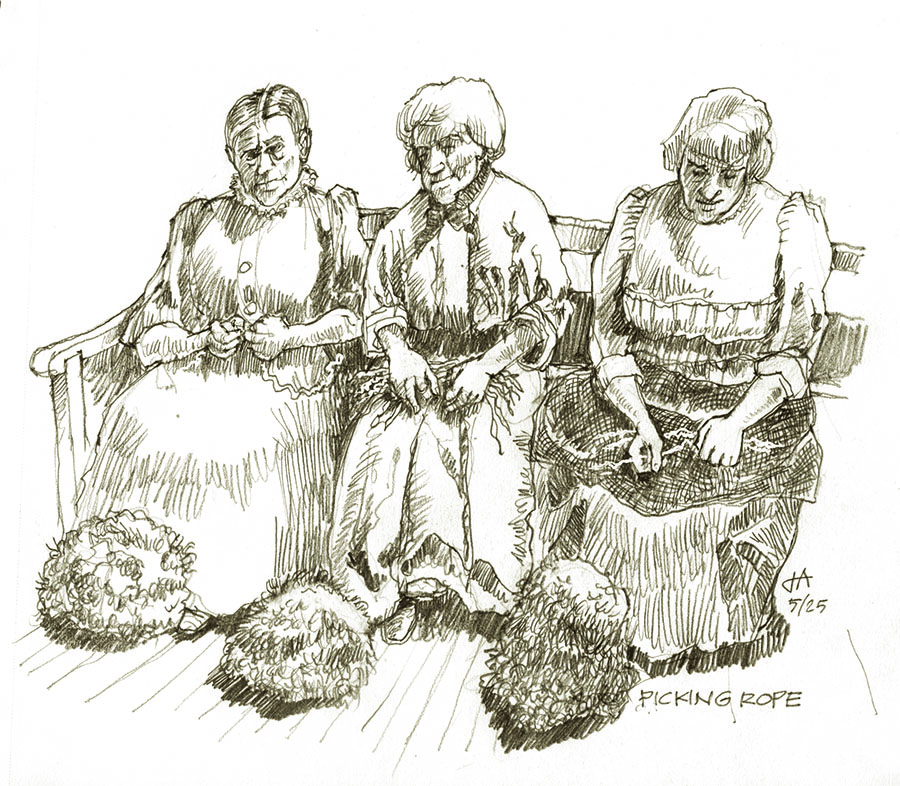
Don’t despair quite yet. There is a time-honored remedy: caulking. A caulker blessed the barkie with resistance to water by using a caulking iron to drive fibrous material into the spaces between planks. When the fiber expanded with moisture, the hull became watertight. The fiber source varied – cotton, hemp, jute, &c. The traditional caulking was oakum (from Old English acumbe, “off-combings”): hemp fiber mixed with tar. The main source of oakum was aging hemp rope. Rope beyond its safe usage, carrying tar from its uses aboard, could be “picked,” disassembled by strands, yarns, and down to the fibers. This was fussy, slow work with little profit. Yet oakum was in constant demand, so its production became a major occupation in poor houses and prisons. Criminals, old folks, the destitute and their families picked rope.
Caulkers in the boatyard readied a new vessel for service. Take even a well-seasoned boat through a lively storm, however, and leaks appear! The formidable forces of the boat’s mast/s versus its structure, and the uneven pounding of irregular waves, wracks and deforms the hull. Unsurprisingly, the hull can spit out its oakum and integrity is compromised.
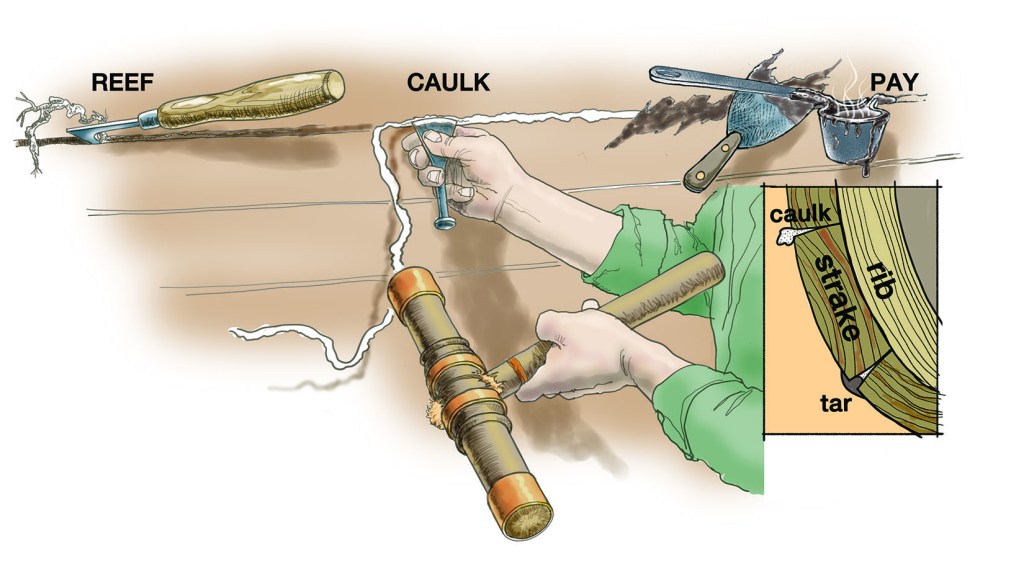
A common chore on every voyage, one of the never-ending tasks, is to recaulk leaking seams. When the area of a leak is identified within, sailors recaulk without from suspended planks or even from the jolly boat. A three step process: reef the seam with a reefing iron, a thin hook to pull out what’s left of the old caulking; caulk with broad caulking irons, driving oakum in with the distinctively shaped caulking hammer; step three, to preserve the oakum and set it firmly in place, pay the seam with molten pine tar – sometimes called Stockholm tar, or pitch, usually extracted from the heartwood of the Scotch Pine, pinus sylvestris.
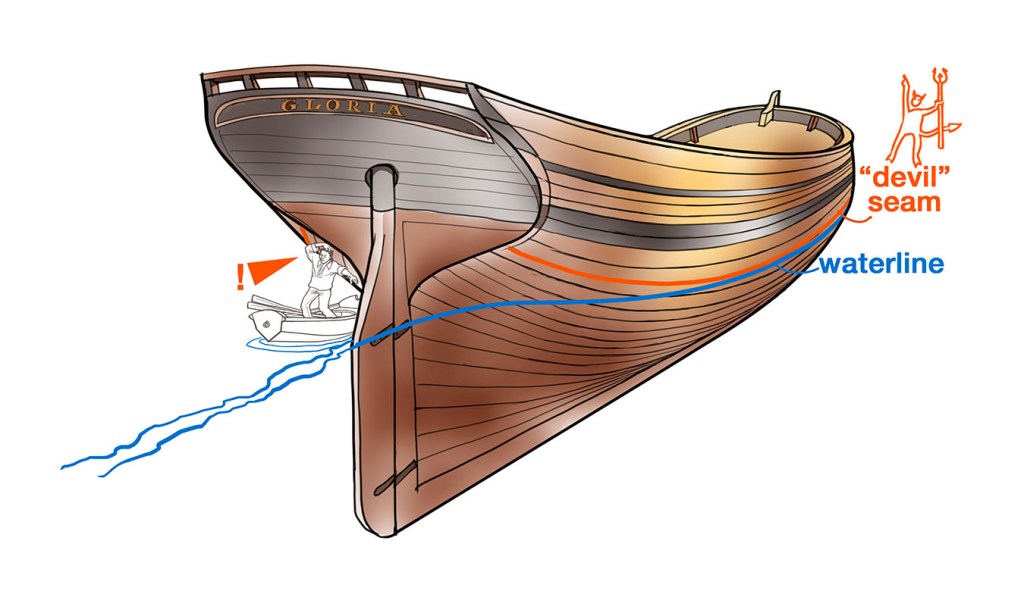
This has been sailor work for thousands of years, inevitable, commonplace. There is one seam, however, worse than all the others. It is the longest seam the barkie offers, running from the cutwater, curving down toward the waterline amidships, and rising toward the stern of a larger vessel right up under the poop, where a rogue wave could slam a hard-working sailor and his jolly boat up against the overhang of the hull.
This vexatious seam is called the devil. When a sailor is recaulking the devil beneath the overhang, he is between the devil and the deep blue sea. And when a shellback sailor needs to express a frustrating, near impossible task, he can say, “There’s the devil to pay and no pitch hot.” That about caps it, you’re in trouble.


Your comment, dissent, data, and support are welcome